
Lawn & Garden • Iowa Lawn Care • Updated October 29, 2026
When to Fertilize Your Lawn in Iowa: ISU Schedule and Rates
Explore related guides: Best broadcast spreaders · Soil test kits · Fall garden cleanup checklist · Gardening in Iowa: all guides · When to plant grass seed in Iowa · Japanese beetles in Iowa.
Most Iowa lawns are Kentucky bluegrass and other cool-season grasses, and they need fertilizer at very different times than the bags in spring store displays suggest. This guide explains when to fertilize your lawn in Iowa, how many applications you need, how much to apply, and what to skip, based on Iowa State University Extension and Outreach guidance.

When to fertilize your lawn in Iowa: the short answer
Iowa State University Extension says cool-season lawns can be fertilized in spring (April or May), mid-September and late October/early November. If you fertilize only once, make it late October or early November, after the grass has stopped growing. Do not fertilize in June, July or August, and never apply more than 1 pound of actual nitrogen per 1,000 square feet at one time.
Iowa lawn fertilizer schedule
ISU Extension says the number of applications depends on how you want your lawn to look and how much care you want to give it:
| Program | Spring (April or May) | Mid-September | Late Oct / early Nov |
|---|---|---|---|
| Minimal: healthy, lower maintenance | — | — | Yes |
| Moderate | — | Yes | Yes |
| High: vigorous, dark green lawn | Yes | Yes | Yes |
One ISU Extension article suggests a slightly lighter spring rate of 0.5 to 0.75 pound of nitrogen per 1,000 square feet, and 0.75 to 1 pound in September and late fall.
Why late fall matters most
- Roots, not just leaves. ISU Extension notes that spring and late summer fertilizer mainly push leaf growth, while a late fall application promotes root development.
- Food for winter. Late fall fertilizer helps the grass store food reserves before winter.
- Earlier spring green-up. Lawns fed in late fall green up earlier the next spring.
- Timing cue. Kentucky bluegrass usually stops growing in late October or early November in Iowa. Fertilize once you have stopped mowing and before the ground freezes.
- Not in summer. Cool-season grasses slow down in summer heat, which is why ISU Extension says not to fertilize them in June, July and August.
How much fertilizer to apply
Fertilizer rates are based on actual nitrogen, the first number on the bag. A 24-0-6 bag is 24% nitrogen. To apply 1 pound of nitrogen per 1,000 square feet:
- Divide 1 by the nitrogen percentage as a decimal: 1 ÷ 0.24 = about 4.2 pounds of product per 1,000 sq ft.
- Multiply by your lawn area in thousands of square feet. A 5,000 sq ft lawn needs about 21 pounds of a 24% product.
- Set your spreader using the bag’s chart, then check it. See our guide to calibrating a broadcast spreader.
Lawn fertilizer calculator
Lawn fertilizer amount calculator
ISU Extension: do not apply more than 1 lb of actual nitrogen per 1,000 sq ft in one application. Always follow the product label.
What kind of fertilizer to use
- Nitrogen is the key nutrient, especially in fall, according to ISU Extension.
- Skip phosphorus unless a soil test calls for it. ISU Extension says most Iowa soils contain enough phosphorus. Look for a middle number of 0, such as 24-0-6. A soil test is the best guide.
- Potassium (the last number) is fine in moderate amounts, but again let a soil test guide you.
- Follow the label. Product labels give spreader settings and legal application rates.
Tips for fertilizing an Iowa lawn
- Sweep up granules that land on driveways, sidewalks and streets so they don’t wash into storm drains.
- Don’t fertilize frozen or snow-covered ground, where fertilizer can run off instead of soaking in.
- Keep mowing at 2½ to 3 inches in fall until the grass stops growing, as ISU Extension recommends.
- Control broadleaf weeds in fall. ISU Extension says late September to early November is the best time to treat perennial broadleaf weeds such as dandelions.
- Rake or mulch leaves. Thick layers of leaves block light and can smother grass; shred light layers with the mower.
Tools for fertilizing your lawn
All four were listed as sold by Amazon.com when checked on October 29, 2026. Check the current listing before you buy.
Best for most lawns: Scotts EdgeGuard DLX
Product pick
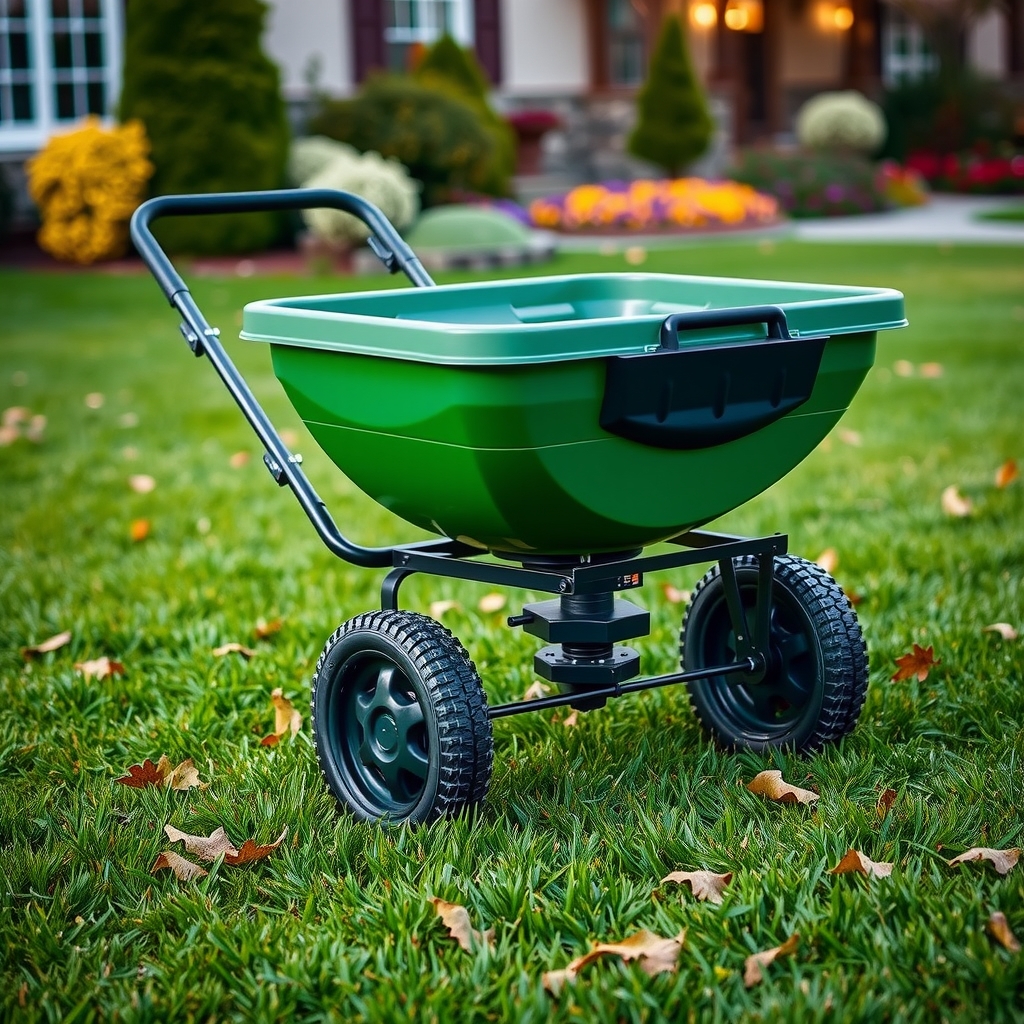
Scotts Turf Builder EdgeGuard DLX Broadcast Spreader
Illustrative image (AI-generated), not the exact product.
A popular push spreader for typical Iowa yards. The EdgeGuard shield blocks fertilizer from going onto driveways and flower beds along the edges.
For larger lawns: Agri-Fab 130 lb Push Spreader
Product pick
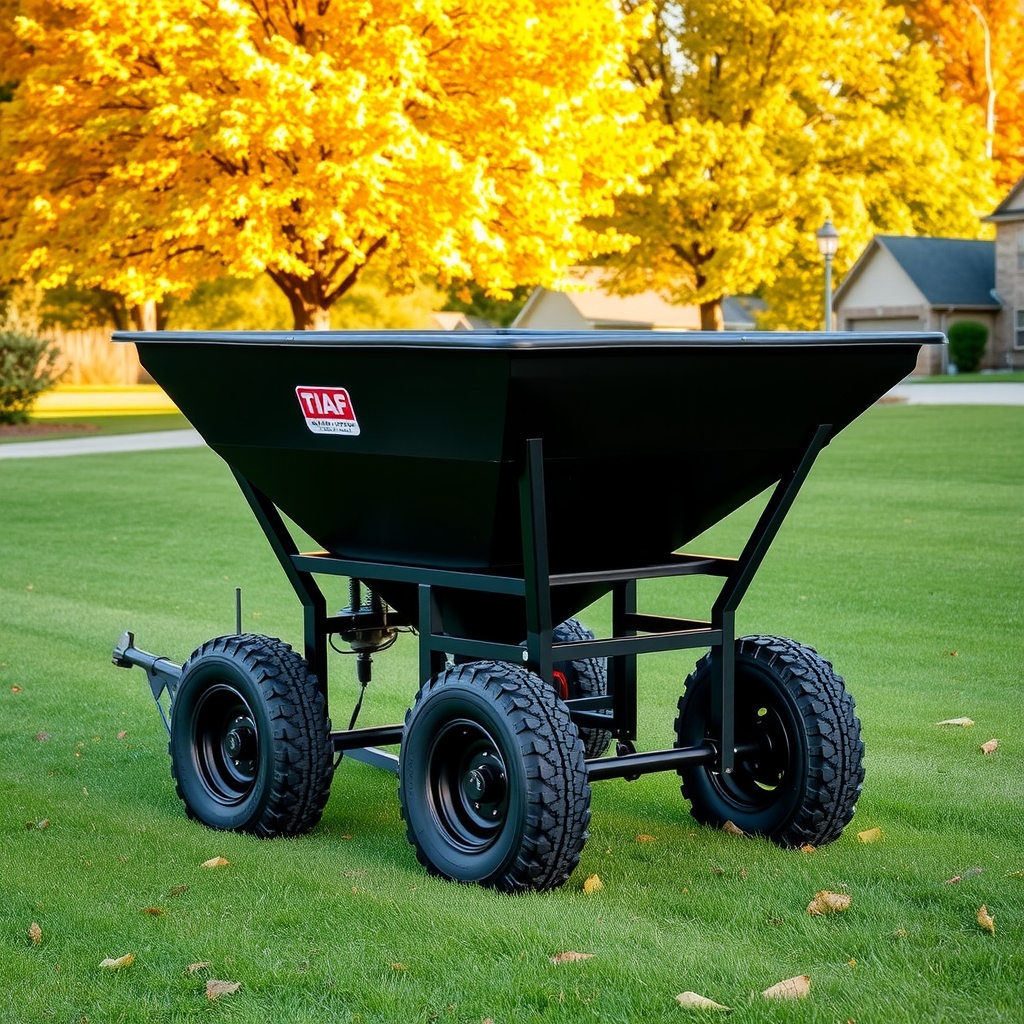
Agri-Fab 45-0614 130 lb Push Broadcast Spreader
Illustrative image (AI-generated), not the exact product.
A larger 130 lb hopper for half-acre lawns, so you stop to refill less often.
For small lawns: Chapin Hand Crank Spreader
Product pick
CHAPIN 8706G 3 lb Hand Crank Lawn Spreader

Illustrative image (AI-generated), not the exact product.
For small lawns, side yards and touch-ups. Easy to store and good for spreading grass seed on thin spots too.
To check your soil first: Luster Leaf Rapitest Digital
Product pick
Luster Leaf 1605 Rapitest Digital Soil Test Kit

Illustrative image (AI-generated), not the exact product.
A quick home check of pH, nitrogen, phosphorus and potassium. For the most accurate results, ISU Extension’s soil testing lab is the gold standard.
FAQs
When is the best time to fertilize a lawn in Iowa?
Late October or early November, once the grass has stopped growing, is the most important application, according to Iowa State University Extension. Mid-September and spring (April or May) are the other good times.
How many times a year should I fertilize my Iowa lawn?
One to three times. ISU Extension suggests one application in late October/early November for a low-maintenance lawn, two (mid-September and late October/early November) for a moderate program, and three (adding spring) for a dark green, high-quality lawn.
Should I fertilize my lawn in summer in Iowa?
No. ISU Extension advises against fertilizing Kentucky bluegrass and other cool-season grasses in June, July and August.
How much fertilizer should I put on my lawn?
No more than 1 pound of actual nitrogen per 1,000 square feet in a single application. Divide 1 by the nitrogen percentage on the bag to get pounds of product per 1,000 square feet; for a 24% nitrogen product that is about 4.2 pounds.
Do Iowa lawns need phosphorus?
Usually not. ISU Extension says most Iowa soils contain enough phosphorus, so apply it only when a soil test shows a need.
Why fertilize the lawn in late fall?
A late fall application promotes root growth, helps the grass store food reserves for winter and gives earlier green-up next spring.
Sources and review scope
This guide was prepared on October 29, 2026 from the following sources and from the product listings on Amazon.com. Homingwell did not perform hands-on testing.
- Iowa State University Extension and Outreach – When should I fertilize my lawn?
- ISU Extension – How often should I fertilize my lawn?
- ISU Extension – Should I fertilize the lawn in summer?
- ISU Horticulture and Home Pest News – Fall lawn care
- ISU Extension Yard and Garden – Handling and caring for lawns in fall
- ISU Extension – Lawn fertilization publication
Explore more Lawn & Garden guides.